
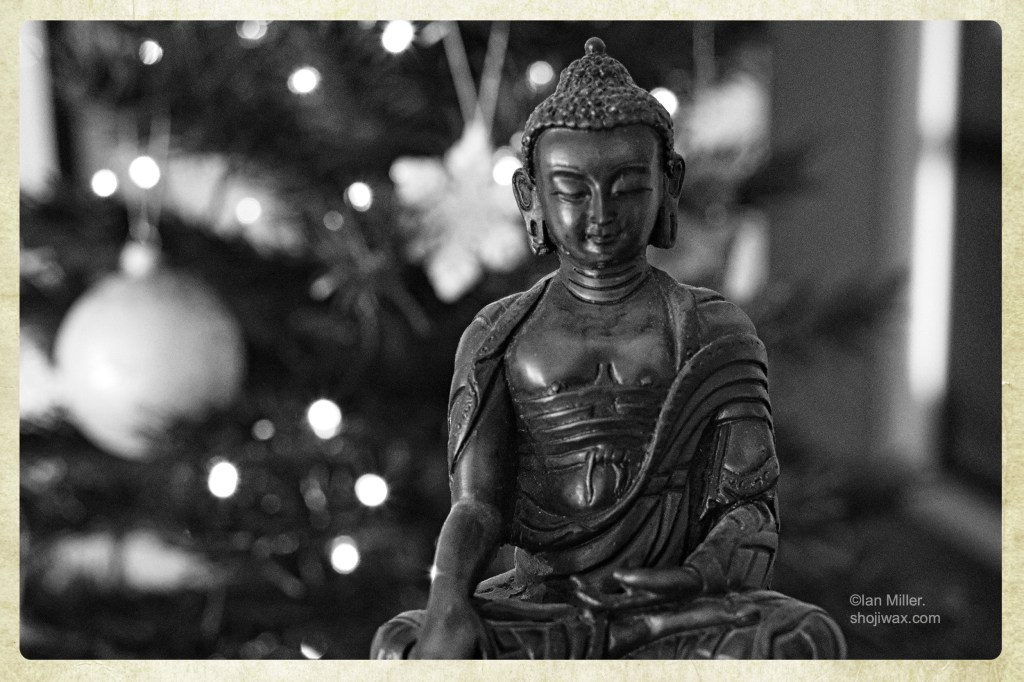
I do not identify as a Christian…so how should I celebrate Christmas?
Over on his substack feed, The Joyous Struggle, Johnathan Rowson writes how Elisabeth Oldfield thinks Christmas can be thought of as three festivals happening at the same time:
- The secular consumerist frenzy festival.
- The mostly pagan inspired festival about winter, darkness, fire and family.
- The Christian festival, about a historical claim of religious importance.
Many of us struggle to tease apart these 3 strands (or braid them together as the case may be)…and figure out if we should be even celebrating, and if so….how?
I don’t know. Other than to say, think about it, but don’t overthink it.
And here is another person, also not a Christian, giving their take on it. And taking into consideration all the horribleness and hatred slopping around the edges of these solstice days….I found it helpful.
Jesus’s birth is heralded by signs. The sign of the star of Bethlehem. And beings who are wise can see this star, recognize this star, and understand its portent… Always interesting in the external story, the three wise men who travel a great distance, none of them are Jewish. They are of other religions…the point of the story is that the wisdom aspects don’t necessarily come from the tradition you’re thinking. And in oneself, there’s always this birth of Jesus coming. There’s always the pregnancy. I was speaking with somebody yesterday about Meister Eckhart’s statement that God is a pregnant nothingness.
It’s so beautiful. That no thingness, that nothingness is our own wisdom mind, and it’s always pregnant and always wishing to give birth and parts of ourselves are always noticing the star of Bethlehem all the time. They’re noticing it and they’re traveling towards it. And the import of the fact that all three Magi are from other traditions.
The import of that. Is that, the wisdom is recognized not necessarily in the parts of ourselves where we expect it to be seen. Wisdom awakens in us in ways we are not expecting. And we need to pay attention. We need to allow it. We need to allow its disruptive force. And that wisdom travels and looks like the three wise men come and they’re coming looking for this new wise being and they look in the parts and places that are least expected.
They don’t go to the synagogue, they don’t go to a temple, they don’t go to a castle or a place of power. They go to a manger. And wisdom chooses to be born in a manger. In the most rejected part. In this place, human beings don’t even belong. Where just animals would live. In the rejected parts of ourselves, in the tossed-out parts of ourselves, in the cut-off parts of ourselves.
Wisdom finds its own birth in those parts. It doesn’t reject anything. It doesn’t choose power as its place of showing itself. You find Jesus’ story in two different places. One in the 40 days in the desert where Satan offers Jesus all forms of power and all forms of pleasure. And you find this in Buddha’s story when Buddha sits through the night before the Maras, the demons of delusion, attack him.
[…] Power and concern with power are always worldly.
There is no other kind of power. As Carl Jung said, where there is the will to power, there is no love. And where there is love, there is no will to power. And so wisdom, which is love, wisdom and love are the same…They are one single thing. When they are alive, they are one single being. So, you have to allow in yourself, always, again and again, no matter what stage of the path you’re on, you have to allow your ordinary tradition. And so inside of you, what is the tradition? Your habits. Your habits are the traditions.
Your habit is the synagogue. Your habits are the Pharisees who uphold and defend the habit teachings. And so you have to allow disruption in your life. You have to allow uncomfort in your life. You have to take account of the parts of yourself you would throw out. You have to look in the places you look away from.
And this is so the divine comes into birth. The divine wishes to come into birth in every moment. In every moment, Jesus is trying to be born.
And Joseph and Mary are looking for a place where that can be born. The male and female aspects, the red and white drops that want to usher in wisdom are looking for a place where wisdom can be born. And it can’t be born in the places where our ego finds its power. They can’t be born in the places where the ego finds its prestige.
It can’t be born in the places where ego feels it wins. That’s where it can’t be born. It can be born in the thrown-out parts and the unaccounted-for parts….
..It’s not about dinner. Christmas is about giving up the known. It’s about the birth of the divine. Coincident with the giving up of the known, the giving up of comfort, the giving up of security. That is, that whole constellation is an event, an event inside yourself, which we celebrate on Christmas. We think about it on Christmas, and we make the most real on Christmas.
And we understand that that birth, that giving up in that birth is not the end of a journey, it’s the beginning. That’s the beginning, again and again, every year. It’s the beginning of the journey of Jesus through his life. With all of its trials and tribulations, with its garden of Gethsemane, with its miracles, with its crucifixion and its resurrection, Christmas is the beginning of that. Moment after moment, after moment, after moment…
— Traktung Khepa (A Tibetan Buddhist teacher).


 shojiwax.com
What say you? Please leave a comment!